
Your dog finishes every meal, wags their tail, and moves on with their day. Everything looks fine. But what if the way they eat is quietly causing them discomfort? Many dog owners never notice the small, gradual changes in their pet’s posture, pace, or enthusiasm at mealtime until a bigger problem appears. Raised feeders are often recommended by veterinarians and pet health advocates as a practical tool for improving posture and reducing strain during meals. Knowing what to look for early gives you the power to make caring, informed choices for your dog’s long-term comfort.
Table of Contents
- How to recognize discomfort: Key signs your dog may need a raised feeder
- Raised feeders vs floor bowls: When does elevation make a difference?
- Raised feeders and health risks: The bloat (GDV) question
- Slow feeders vs raised feeders: Which is the smart choice for fast eaters?
- Why most dog owners miss early feeding discomfort—and what truly matters
- Ready to improve your dog’s feeding experience?
- Frequently asked questions
Key Takeaways
| Point | Details |
|---|---|
| Spot discomfort early | Watch for subtle mealtime behaviors that suggest your dog has difficulty using a floor-level bowl. |
| Match feeder to needs | Some dogs benefit most from raised feeders, while others may need slow feeders to prevent rushing and bloat. |
| Consult your veterinarian | Always discuss feeder changes with your vet, especially for dogs at heightened risk of bloat or with existing health issues. |
| Monitor results | Observe your dog’s posture and meal enjoyment after any feeding system change to ensure comfort and safety. |
How to recognize discomfort: Key signs your dog may need a raised feeder
Mealtime discomfort in dogs is rarely dramatic. It tends to show up in small, easy-to-miss behaviors that build over time. By the time most owners notice something is wrong, the dog has often been compensating for weeks or even months. Understanding these signals helps you act before the problem worsens.
As the American Kennel Club notes, reluctance to bend to reach the bowl, pain or discomfort when eating from floor-level bowls, and visible difficulty maintaining a comfortable posture during meals are common indicators that something needs to change.
Here are nine specific signs to watch for:
- Struggling to lower their head to the bowl. If your dog pauses, repositions, or seems to hesitate before reaching down, they may be experiencing neck or shoulder tension.
- Appearing stiff or slow after meals. Post-meal stiffness, especially in older dogs, can indicate that the repeated bending motion is straining joints.
- Selective or inconsistent eating. A dog that eats enthusiastically some days and barely touches the bowl on others may be managing pain or discomfort at the source.
- Shifting weight or changing stance while eating. Constantly adjusting their feet or leaning to one side suggests they are trying to find a more comfortable angle.
- Dropping food frequently. When a dog has to crane their neck far down, food often falls out of their mouth. This is not always a behavioral issue; it can be a posture issue.
- Showing bowl aversion. Approaching the bowl and then backing away, or eating only part of a meal and walking off, can signal that eating is uncomfortable rather than enjoyable.
- Coughing or gagging during meals. Swallowing at an awkward angle can cause food or water to go down the wrong way, leading to coughing fits that owners often dismiss.
- Gulping water excessively after eating. Some dogs drink large amounts of water post-meal because the act of eating was physically taxing. This can also increase bloat risk.
- Visible muscle tension around the neck and shoulders. Gently run your hands along your dog’s neck after a meal. Tightness or flinching in that area is a meaningful signal.
These signs are especially worth monitoring in senior dogs. Elevated feeding for seniors addresses how aging joints and reduced flexibility make floor-level bowls increasingly problematic over time. The cumulative effect of daily strain matters, and catching it early makes a real difference.
Raised feeders vs floor bowls: When does elevation make a difference?

Not every dog needs a raised feeder. But for many, the switch from a floor bowl to an elevated stand produces noticeable improvements in comfort, posture, and eating pace. The key is understanding when elevation genuinely helps versus when it is simply a design preference.
Elevated bowls are frequently marketed to reduce neck and joint strain by allowing a more upright or neutral head and neck position while eating. This is especially relevant for large and giant breeds, dogs with arthritis, and dogs recovering from neck or spine injuries.
Here is a side-by-side comparison to help you evaluate both options:
| Feature | Floor bowl | Raised feeder |
|---|---|---|
| Neck and joint strain | Higher, especially for tall dogs | Reduced with proper height |
| Posture during meals | Head bent down sharply | More neutral, upright position |
| Ease of eating | Harder for dogs with mobility issues | Easier for seniors and large breeds |
| Spill and mess | More common with active eaters | Often reduced with stand stability |
| Bloat risk | Neutral for most dogs | Debated; see section below |
| Cleaning | Simple, portable | Slightly more involved |
| Best for | Small dogs, young healthy dogs | Large breeds, seniors, dogs with joint issues |
The table makes one thing clear: context matters. A healthy, small-breed puppy may do perfectly well with a floor bowl for years. A Great Dane or a 10-year-old Labrador with stiff hips is a very different story.
Pro Tip: If your dog is a long-legged breed such as a Greyhound, Irish Wolfhound, or Standard Poodle, the distance between their mouth and a floor bowl is significant enough that elevation almost always improves comfort. Measure from the floor to your dog’s lower chest and subtract about two inches to find an appropriate feeder height.
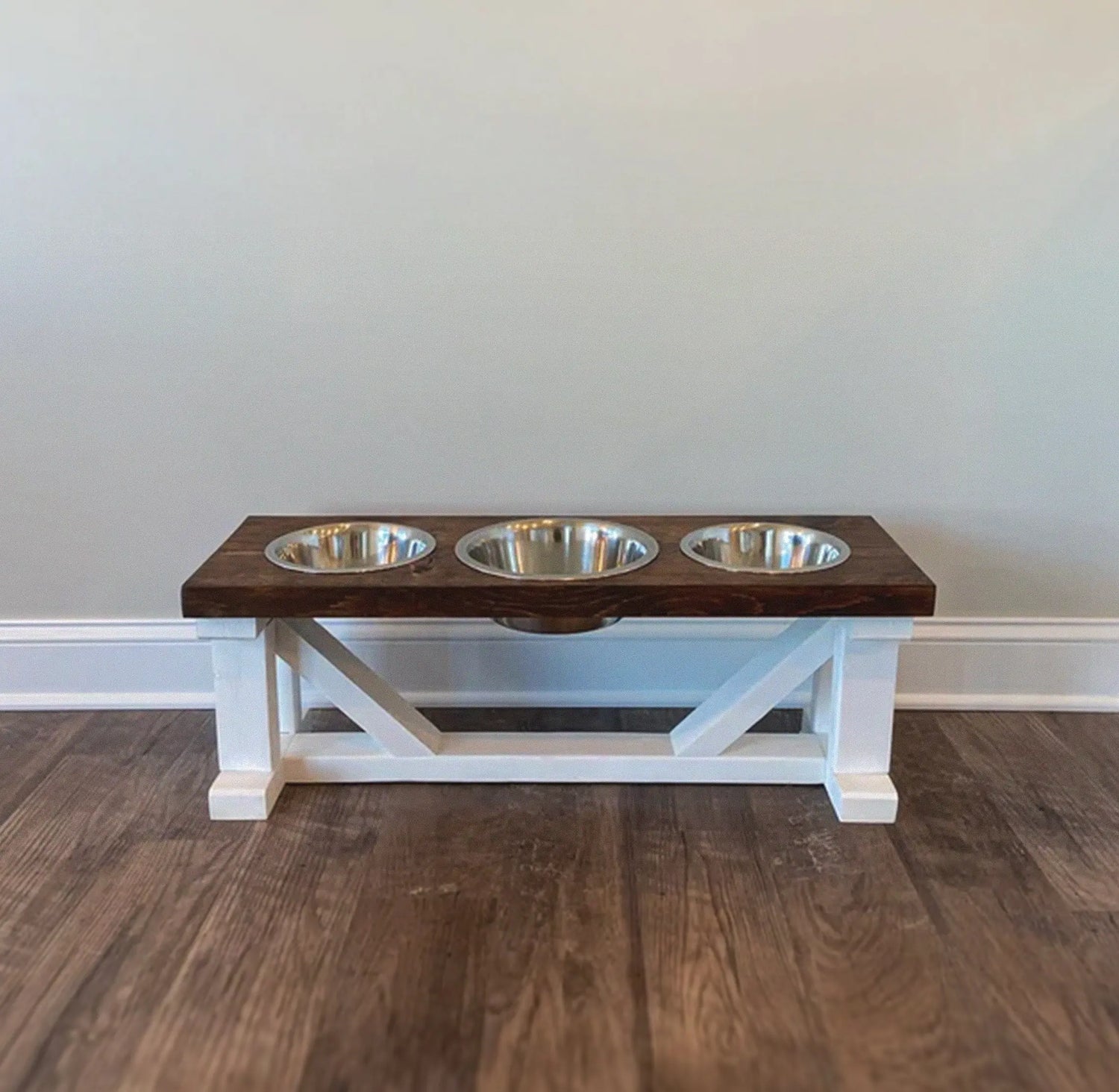
Pairing the right feeder with healthy dog treats during training or mealtime transitions can also help your dog associate the new setup with positive experiences. A well-crafted wooden elevated dog feeder not only supports better posture but also adds a clean, functional look to your home.
Raised feeders and health risks: The bloat (GDV) question
Before you make any changes to your dog’s feeding setup, there is one health topic you need to understand: gastric dilatation-volvulus, commonly called GDV or bloat. This is a serious and potentially life-threatening condition where the stomach fills with gas and twists on itself. It requires emergency veterinary care and can be fatal within hours if untreated.
Large and giant breeds with deep chests are at the greatest risk. Breeds like Great Danes, German Shepherds, Standard Poodles, Weimaraners, and Saint Bernards are frequently cited in veterinary literature as higher-risk populations. Eating too fast, eating one large meal per day, and exercising immediately after eating are all known contributing factors.
Here is a quick summary of what current research tells us about raised feeders and GDV risk:
| Risk factor | What the research says |
|---|---|
| Elevated feeders and bloat | Results are mixed; some studies show increased risk in large breeds, others show no clear link |
| Fast eating | Consistently linked to higher GDV risk across multiple studies |
| Breed and chest depth | Deep-chested, large breeds face significantly higher baseline risk |
| Meal frequency | One large meal per day increases risk compared to two smaller meals |
| Vet guidance | Essential for any dog with known risk factors before changing feeder type |
The most responsible approach is clear. The safest path for dogs at increased risk for bloat is individualized veterinary guidance rather than automatically choosing an elevated feeder. This is not a reason to avoid raised feeders entirely. It is a reason to make the decision thoughtfully, with your vet’s input.
If your dog is a small or medium breed with no history of digestive issues, the bloat concern is far less pressing. You can shop elevated feeders with confidence once you have ruled out significant risk factors with your veterinarian.
Slow feeders vs raised feeders: Which is the smart choice for fast eaters?
Here is where many dog owners get confused. They see their dog eating too quickly, they want to help, and they wonder whether a raised feeder or a slow feeder is the right solution. The answer depends entirely on why your dog is eating the way they are.
A slow feeder is a bowl designed with ridges, mazes, or raised sections that force a dog to eat around obstacles, naturally slowing their pace. A raised feeder is a stand that elevates the bowl to a more comfortable height. These are two different tools solving two different problems.
For fast eaters, a slow feeder may be more effective than simply switching to a raised bowl, because elevated access could actually make gulping faster and worsen GDV risk in susceptible dogs. Elevation alone does not slow eating. In some cases, it makes food more accessible and speeds the process up.
Here is how to match the feeder to the behavior:
Choose a slow feeder if your dog:
- Finishes a full meal in under two minutes
- Gulps food without chewing
- Vomits or regurgitates shortly after eating
- Appears frantic or anxious at mealtime
- Has a history of digestive upset after meals
Choose a raised feeder if your dog:
- Shows signs of neck or joint strain while eating
- Is a senior dog with reduced flexibility
- Drops food frequently due to posture
- Has been diagnosed with arthritis or a spinal condition
- Is a large or giant breed with a deep chest and no bloat risk history
Consider both if your dog:
- Is a large breed senior who also eats quickly
- Has joint issues but also shows signs of gulping
- Has been recommended both by a vet for different reasons
Pro Tip: Test one change at a time. Introduce a slow feeder for one week and observe your dog’s pace, digestion, and post-meal behavior. Then try a raised feeder for a week and compare. Changing both at once makes it impossible to know which adjustment made the difference.
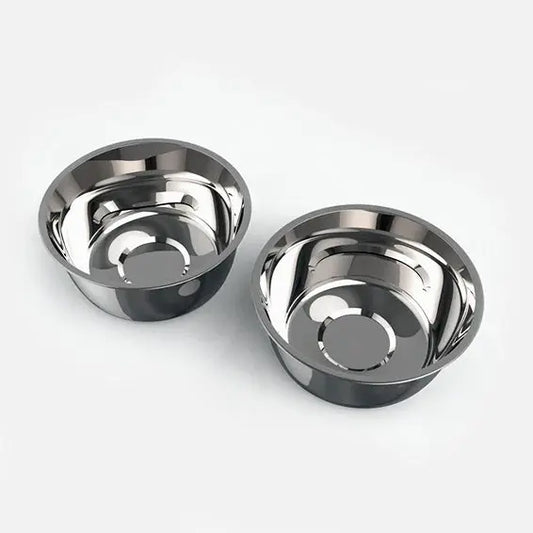
A two-bowl elevated feeder works well for households with multiple dogs or for dogs that need separate food and water stations at the right height. For dogs who need durability and easy cleaning alongside elevation, a metal raised dog feeder offers a practical and long-lasting option.
Why most dog owners miss early feeding discomfort—and what truly matters
Here is the honest truth: most dog owners are not negligent. They are simply not trained to observe the subtle language of physical discomfort in animals. Dogs do not complain. They adapt. They compensate. They keep showing up to the bowl even when it hurts, because eating is a drive that overrides mild pain.
That adaptation is exactly what makes early signs so easy to miss. A dog that shifts their weight while eating is not being quirky. A dog that coughs once or twice during meals is not just being clumsy. These are small signals that something about the feeding experience is not quite right for their body. By the time the behavior becomes obvious, the discomfort has usually been present for a long time.
We have seen this pattern repeatedly in feedback from dog owners who switched to elevated feeders for comfort for senior dogs. Many of them say something like, “I wish I had done this sooner.” They noticed the improvement immediately once the feeder height matched their dog’s needs, and they realized in hindsight that the signs had been there for months.
The bigger lesson here is not just about feeders. It is about building a habit of attentive observation. Watch your dog eat at least a few times a week with your full attention. Notice their posture, their pace, their energy level before and after meals. Track changes over weeks, not just days. And when something shifts, take it seriously rather than waiting to see if it resolves on its own.
The right feeder is a meaningful tool. But the real advantage goes to the dog owner who combines the right product with consistent, caring observation.
Ready to improve your dog’s feeding experience?
If the signs in this article sound familiar, your dog may be telling you something important. At Bearwood Essentials, we design handcrafted elevated feeders built to support your dog’s comfort, posture, and long-term health. Every product is made with quality materials and functional design so you can feel confident in what you are placing in front of your pet every day.
Explore our wooden elevated feeder for a warm, natural aesthetic that fits beautifully in any home, or browse our metal raised feeder for a sleek, durable option that is easy to clean and built to last. Ready to find the right fit for your dog? Shop all elevated feeders and take the first step toward healthier, more comfortable mealtimes.
Frequently asked questions
Are raised feeders recommended for all dog breeds?
No, not every breed needs a raised feeder; the benefits depend on size, age, and health status. It is best to consult a veterinarian for breed and health-specific advice before making the switch.
Can a raised feeder prevent my dog from developing arthritis?
Elevated feeders can reduce neck and joint strain, but they cannot prevent arthritis; genetics, weight, and overall care play much larger roles. That said, reducing joint strain during daily meals is still a meaningful step toward long-term comfort.
How do I know if my dog is uncomfortable during meals?
Watch for reluctance to bend, frequent weight shifting, or signs of pain when eating from the ground. Discomfort at mealtime may also appear as bowl aversion or coughing during meals.
Should I switch to an elevated feeder if my dog eats too quickly?
For fast eaters, a slow feeder is often more effective than a raised bowl at reducing gulping and digestive risk. Slow feeders are preferable for dogs that eat too fast, rather than simply switching to a raised bowl.
Can using a raised feeder cause bloat in dogs?
The link between elevated feeders and bloat is still debated in veterinary research, and the risk varies by breed and individual health history. Veterinary guidance is recommended before switching to an elevated feeder for breeds prone to bloat.