
Most dog owners spend real time choosing kibble, treats, and supplements — then grab whatever bowl looks good without a second thought. But how bowl depth affects dog eating is one of the most overlooked factors in your dog’s daily comfort and long-term health. The wrong bowl depth can strain your dog’s neck, cause them to gulp air, or make mealtime genuinely stressful. Get it right, and you will notice calmer eating, better digestion, and a happier dog at every meal.
Table of Contents
- Key takeaways
- How bowl depth affects dog eating posture and comfort
- Bowl depth, eating speed, and digestion
- Breed-specific bowl depth considerations
- Choosing and adjusting the right bowl depth
- My honest take on bowl depth after years of watching dogs eat
- Find the right bowl for your dog at Bearwoodessentials
- FAQ
Key takeaways
| Point | Details |
|---|---|
| Bowl depth changes posture | Bowls that are too deep force dogs to crane their necks, causing strain during every meal. |
| Deep bowls speed up eating | Dogs eating from deep bowls tend to gulp food faster, increasing the risk of digestive upset. |
| Breed matters for bowl shape | Flat-faced, long-eared, and large breeds each need specific bowl depths and widths to eat comfortably. |
| Slow feeders reduce health risks | Slow feeder bowls cut eating speed significantly and lower the risk of aerophagia and bloat. |
| Right capacity prevents overflow | Choose a bowl with a capacity 1.5 to 3 times your dog’s meal size to prevent spills and frustration. |
How bowl depth affects dog eating posture and comfort
Picture your dog at mealtime. Are they standing tall with a relaxed neck, or are they practically nose-diving into the bowl, shoulders hunched, back end raised? That posture tells you a lot about whether their bowl is working for them or against them.
The ideal eating posture for a dog involves a gently lowered head, a relaxed neck, and a spine that stays mostly level. A bowl that forces too much downward reach throws that posture off entirely. Bowls set too low cause neck and shoulder strain that compounds over months and years, especially in older dogs or breeds prone to joint issues.
Deep bowls create a specific problem beyond height. When a bowl has significant depth, a dog has to push their face further down and forward to reach food at the bottom. Smaller dogs especially end up in what you might call a “face-dive” position, with their whole front end angled into the bowl. Wide, shallow bowls reduce this problem by keeping food accessible at the surface, encouraging a natural eating angle.
Here is what good bowl depth does for your dog’s body:
- Keeps the neck at a comfortable downward angle without forcing a sharp bend
- Reduces pressure on the shoulders and front legs during the full length of a meal
- Allows the dog to see and access food without straining forward or sideways
- Supports relaxed jaw movement, which means more thorough chewing
Pro Tip: Watch your dog eat for 60 seconds before switching bowls. If their elbows are splayed outward or their nose is fully submerged, the bowl is almost certainly too deep for comfortable posture.
Older dogs with arthritis, dogs recovering from neck injuries, and long-necked breeds like Greyhounds and Dobermans feel the effects of bowl depth more acutely than young, healthy mixed breeds. For these dogs, getting the depth right is not a preference. It is a genuine health consideration.
Bowl depth, eating speed, and digestion
Here is something most owners do not connect: the shape of your dog’s bowl directly influences how fast they eat. And eating speed is one of the clearest predictors of digestive distress.
Dogs that eat meals in under 30 seconds are at higher risk for gulping air, which causes gas, discomfort, and in the worst cases, contributes to bloat. Deep bowls unintentionally encourage this. A dog eating from a deep bowl has to work their snout into a confined space, which disrupts their natural lapping rhythm and pushes them toward fast, aggressive scooping motions. The result is more swallowed air with every bite.
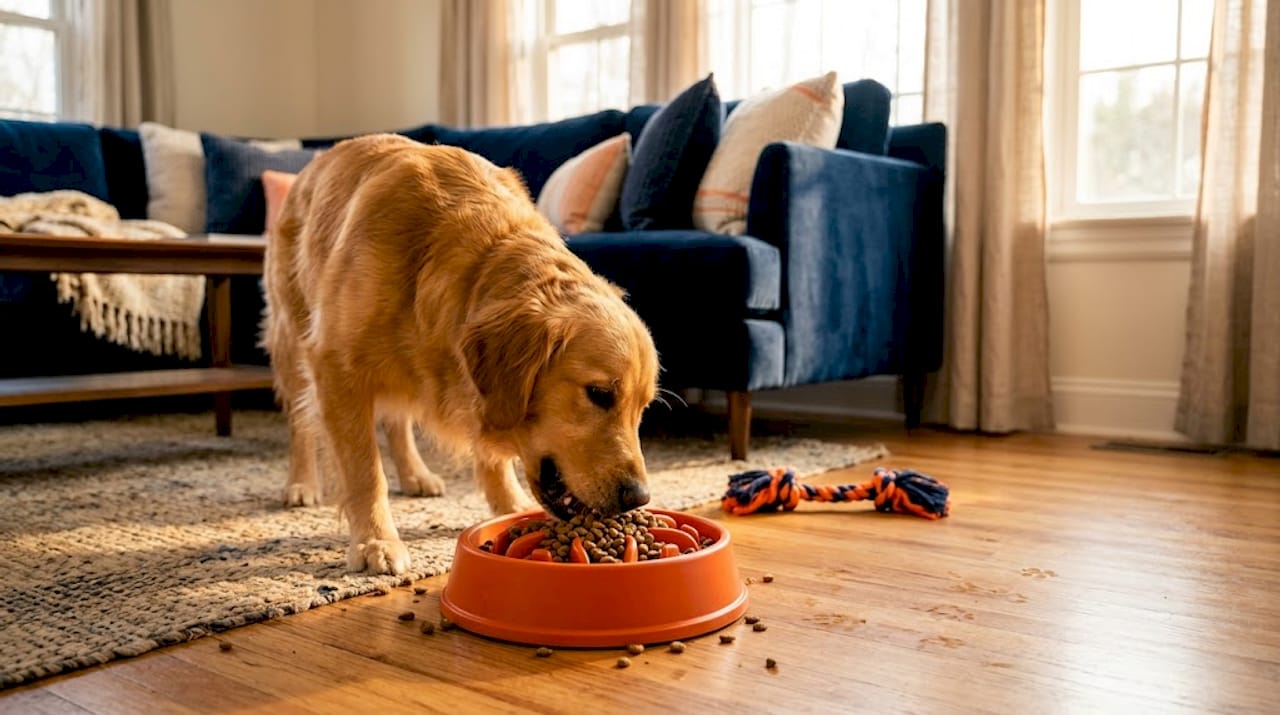
Shallow or slow feeder bowls work differently. The food is spread across a wider surface, which naturally forces a dog to work for each bite rather than inhale the whole meal in one sweep. Slow feeders reduce eating speed by 5 to 10 times compared to standard deep bowls. That alone can dramatically lower aerophagia risk and improve digestion across the board.
The bloat concern deserves specific attention. Gastric Dilatation-Volvulus (GDV) is a life-threatening condition where the stomach fills with gas and twists on itself. Large, deep-chested breeds including Great Danes, German Shepherds, Weimaraners, and Standard Poodles are most vulnerable. A Purdue University study found a link between raised bowls and increased bloat risk in these breeds, which surprised many owners who believed elevation was universally beneficial.
Veterinarians often recommend slow feeder bowls specifically for dogs prone to gulping because the mechanical change in eating speed reduces digestive strain without requiring medication or behavioral training.
One more factor people miss: bowl stability. Slippery bowls increase gulping and stress because dogs are simultaneously trying to eat and chase the bowl across the floor. A heavy ceramic or stainless steel bowl with a non-slip base keeps the feeding experience calm and controlled, which supports better digestion without any other changes.
Breed-specific bowl depth considerations
Not every dog eats the same way, and not every snout fits the same bowl. Breed characteristics including face shape, ear length, and overall size play a major role in determining the best bowl depth for your dog.
| Breed type | Recommended bowl style | Why it matters |
|---|---|---|
| Flat-faced breeds (Bulldogs, Pugs) | Wide, shallow bowl | Deep bowls press against the cheeks and restrict breathing during eating |
| Long-eared breeds (Basset Hounds, Spaniels) | Narrow, moderately deep bowl | Keeps ears out of food, reducing ear infections and mess |
| Long-nosed breeds (Collies, Greyhounds) | Moderate depth and width | Allows snout access without forcing face fully into the bowl |
| Large and giant breeds | Large capacity, moderate depth | Proportional to meal size; prevents frustration from under-capacity bowls |
| Small breeds under 20 lbs | Shallow, wide bowl | Reduces face-dive posture and keeps eating at a comfortable angle |
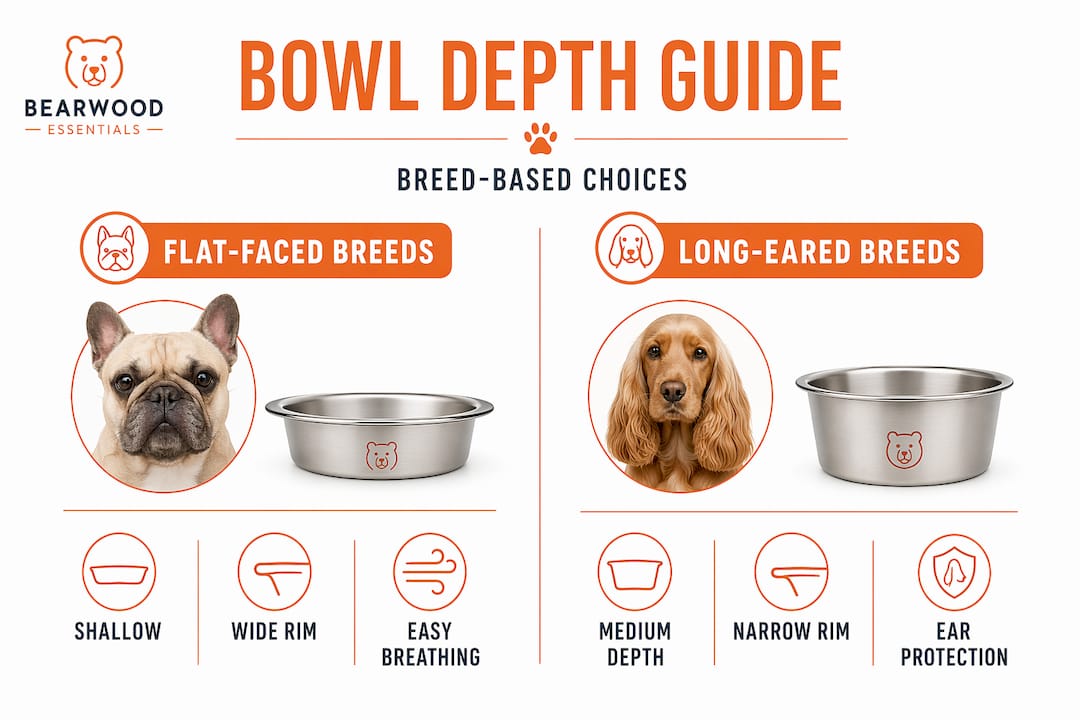
Flat-faced breeds, also called brachycephalic dogs, deserve extra care here. Their shortened airways already make breathing more effortful than other breeds. A deep bowl that presses against both cheeks during eating adds real physical resistance to an already compromised system. Wide, shallow bowls give these dogs room to eat without fighting the bowl for space.
For long-eared dogs like Basset Hounds, Cocker Spaniels, and Afghan Hounds, wide shallow bowls cause ear contact with food on almost every bite. That leads to chronic ear moisture, food buildup, and a higher rate of ear infections. A narrower bowl with moderate depth keeps those ears draped outside the rim rather than soaking in the kibble.
Pro Tip: If your long-eared dog seems to shake their head frequently after meals, check whether their ears are touching the bowl contents. Switching to a narrower, deeper bowl often resolves this within a week.
Large and giant breeds need bowls sized to their actual meal portion. Bowl capacity should be 1.5 to 3 times the meal size to prevent overflow without wasting space. For giant breeds eating 8 to 12 cups per meal, a wide but proportionally shallower bowl prevents the nose-dive problem while still holding the full portion comfortably.
Choosing and adjusting the right bowl depth
Getting to the right bowl setup is less complicated than it sounds. A few focused observations and one or two practical steps will get you to something that genuinely works for your dog.
-
Measure your dog’s meal size first. Fill their current portion into a measuring cup, then choose a bowl that holds 1.5 to 2 times that volume. This prevents overflow without giving your dog a bowl so large they have to stretch their neck flat to reach the bottom.
-
Watch posture during the first meal in any new bowl. The clearest sign of a depth problem is a dog whose front legs spread wide or whose nose fully disappears into the bowl. Both signs point to a bowl that is too deep for comfortable access.
-
Prioritize non-slip bases. A bowl that slides across the floor adds stress and speeds up eating. Heavy stainless steel or ceramic with a rubber base keeps the bowl in place and the dog calmer. This is especially helpful for anxious eaters.
-
Introduce slow feeders gradually. If your dog currently inhales meals in seconds, a slow feeder insert or a purpose-built slow feeder bowl is worth adding. Start with 30% of their meals in the new bowl and increase over a week to reduce frustration during the transition.
-
Revisit bowl depth as your dog ages. A deep bowl that worked fine for a two-year-old Labrador may become uncomfortable at eight when joint stiffness sets in. Older dogs often benefit from a transition to shallower bowls paired with a gentle height adjustment. The guidance on raised bowl safety is worth reviewing before you raise any bowl for a large breed.
Pro Tip: If your dog walks away mid-meal repeatedly, they are not being picky. They are likely uncomfortable with the bowl depth, height, or stability. Treat this as useful feedback, not a behavior problem.
Bowl design and depth should always be matched to your dog’s actual physical needs and behavior patterns rather than defaulting to what looks standard. Your dog cannot tell you the bowl is wrong. Their eating behavior will, if you pay attention.
My honest take on bowl depth after years of watching dogs eat
I will be direct: most bowl advice you find online treats depth and size as afterthoughts. The focus goes to elevated versus floor level, or stainless steel versus plastic, while depth gets a single sentence at the end of the article if it gets mentioned at all.
What I have seen over time is that bowl depth is often the first thing to address when a dog is eating too fast, spilling food constantly, or avoiding their bowl partway through a meal. Those behaviors almost always have a physical explanation, and bowl geometry is high on the list.
I have watched owners switch from a standard deep bowl to a wide, shallow option and see a noticeable change in eating pace within days. No training. No supplements. Just a bowl that fit the dog’s face properly. The dog stopped spraying kibble across the kitchen floor and started chewing instead of inhaling.
The harder challenge is convincing someone with a large breed dog to take the bloat risk seriously. The Purdue research on elevated bowls and GDV does not mean every raised bowl is dangerous. It means depth, height, and breed all interact, and that combination needs to be considered together rather than in isolation.
My honest advice: forget the idea that there is one correct bowl setup. There is only the setup that matches your specific dog, their breed characteristics, their age, and their eating behavior. Observe first. Adjust after.
— Kim
Find the right bowl for your dog at Bearwoodessentials
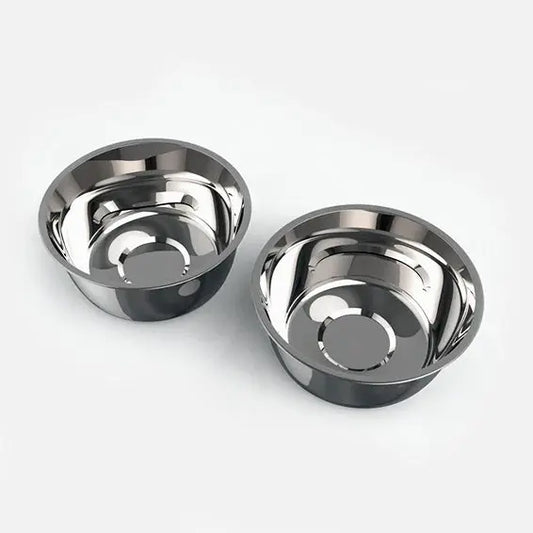
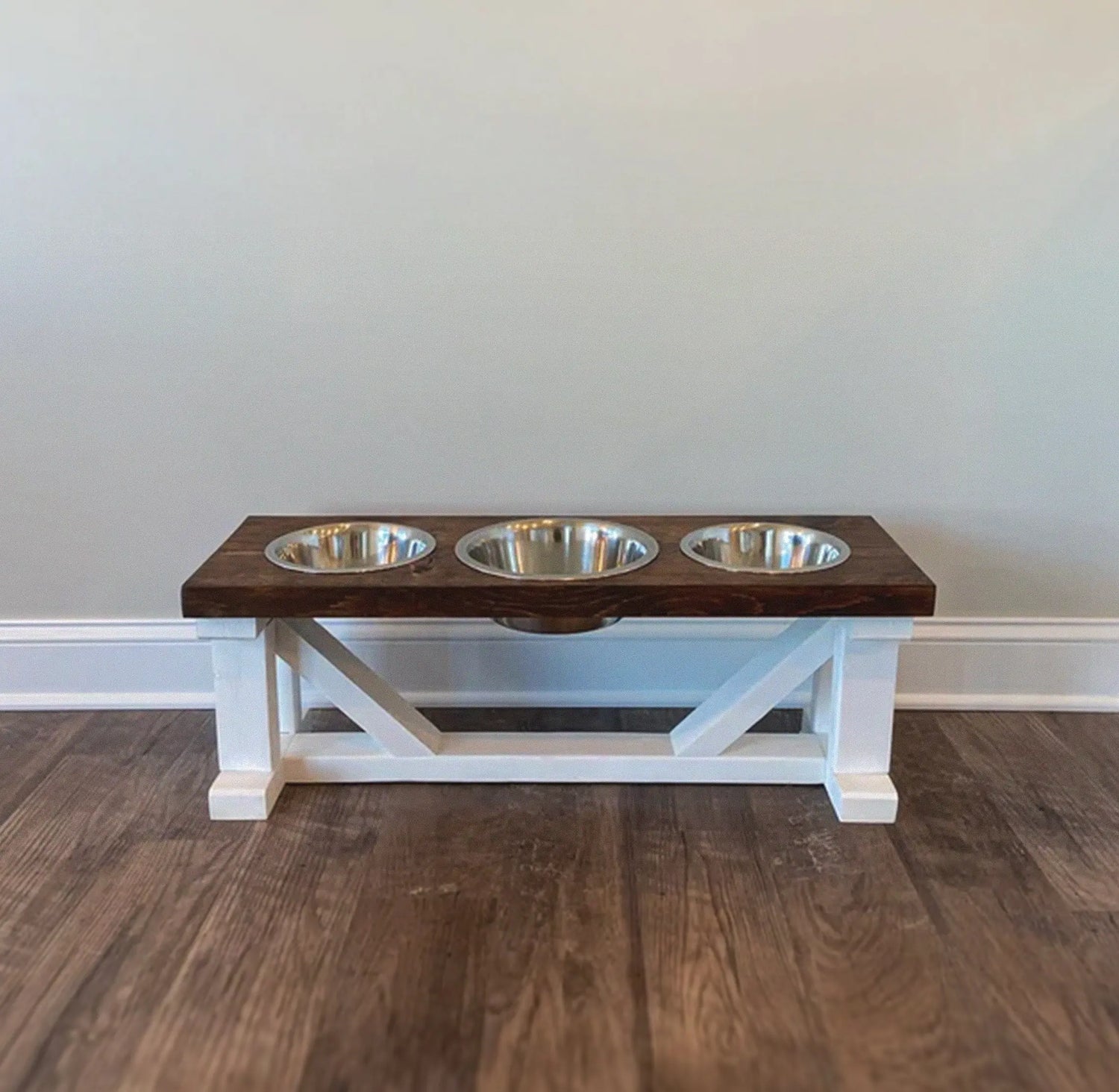
At Bearwoodessentials, every feeder is designed with your dog’s comfort in mind, not just appearance. The handcrafted pet feeder replacement bowls come in multiple sizes and depths to match a range of breeds, meal sizes, and eating needs. Whether you have a small dog that needs a wide, shallow bowl to stay comfortable or a large breed that requires a proportional bowl with a stable, non-slip base, there is an option built for that. The Large Single Feeder P899 is a solid choice for bigger breeds, combining thoughtful bowl depth with the elevated stand design that supports healthy posture. Free U.S. shipping is available on qualifying orders.
FAQ
How deep should a dog bowl be?
Ideal bowl depth depends on your dog’s breed and snout length. Shallow bowls work best for flat-faced breeds and small dogs, while moderate depth suits long-nosed or large breeds. The goal is a bowl that allows comfortable access without forcing the dog to push their face fully inside.
Can a dog bowl that is too deep cause health problems?
Yes. Deep bowls can force an uncomfortable eating posture that strains the neck and shoulders over time. They also encourage faster eating and air gulping, which raises the risk of digestive upset and, in large deep-chested breeds, contributes to bloat risk.
What is the best bowl depth for dogs that eat too fast?
A shallow or slow feeder bowl is the best solution. Slow feeders cut eating speed by 5 to 10 times compared to standard bowls, reducing the amount of air swallowed and giving the digestive system more time to respond properly.
Do long-eared dogs need a special bowl depth?
Yes. Narrow, moderately deep bowls keep a long-eared dog’s ears outside the bowl rim during eating. Wide, shallow bowls allow ear contact with food, which creates chronic moisture and increases the likelihood of ear infections.
How do I know if my dog’s bowl depth is wrong?
Watch for these signs: front legs splayed during eating, nose fully submerged, food scattered far from the bowl, frequent pauses or walking away mid-meal, and rapid eating with visible gulping. Any of these signals that the bowl depth or size is not matching your dog’s physical needs.