
Many large breed dog owners invest in elevated feeders expecting an automatic health upgrade, only to discover the reality is more nuanced. The correct bowl height for large breeds is not one universal measurement, and getting it wrong can cause as much discomfort as feeding off the floor entirely. There is also a genuine safety debate around raised bowls and bloat risk that deserves your attention before you buy. This guide cuts through the confusion, giving you the exact tools to measure your dog, weigh the evidence, and make a confident feeding decision.
Table of Contents
- Why bowl height matters for large dog breeds
- Potential health risks of elevated bowls for large breeds
- How to measure the correct bowl height for your large dog
- Balancing comfort and safety: slow feeders and feeding strategies
- Choosing the right elevated feeder stand and bowls for your home and dog
- Why the conventional wisdom on raised dog bowls needs reconsideration
- Elevate your large dog’s feeding experience with Bearwood Essentials
- Frequently asked questions
Key Takeaways
| Point | Details |
|---|---|
| Measure precisely | Measure from floor to your large dog’s elbow and subtract 3–6 inches for ergonomic bowl height. |
| Ergonomic benefits | Correct bowl height reduces neck and back strain, especially for senior or arthritic dogs. |
| GDV risk caution | Elevated bowls may increase bloat risk in deep-chested large breeds, so vet consultation is important. |
| Use slow feeders | Combine raised bowls with slow feeder designs to reduce fast eating and airway intake. |
| Adjust over time | Reassess bowl height regularly to accommodate your dog’s growth, age, and mobility changes. |
Why bowl height matters for large dog breeds
Feeding posture affects more than how comfortable your dog looks at mealtime. It directly influences neck and spine alignment, which matters especially for large breeds whose bodies carry significant weight and muscle tension throughout each day. When a dog repeatedly crouches down to floor-level bowls, the strain on the cervical spine (the neck vertebrae) accumulates over time, much like how poor desk posture affects human workers.
The role of bowl height in dog health becomes especially clear when you observe senior dogs with arthritis or hip dysplasia. These dogs often hesitate at the bowl, shift weight awkwardly, or eat in short, uncomfortable bursts. Raising the bowl to the right position removes that physical barrier entirely. Research supports elevated feeding for senior dogs as a meaningful quality-of-life improvement.
Key reasons why getting the optimal bowl height right for your dog matters:
- Neutral neck position: A correctly raised bowl keeps the head and neck in line with the spine, reducing chronic muscle tension.
- Reduced crouching: Large breeds forced to spread their front legs wide to reach a floor bowl put uneven stress on joints, particularly the shoulders and elbows.
- Improved swallowing: Food moves more naturally from mouth to stomach when a dog does not need to tilt its neck steeply downward.
- Arthritis management: For older dogs, even a modest height adjustment can make eating pain-free again.
- Less mess: A raised bowl at the right height also limits splashing, as dogs are not plunging their muzzles down at an angle.
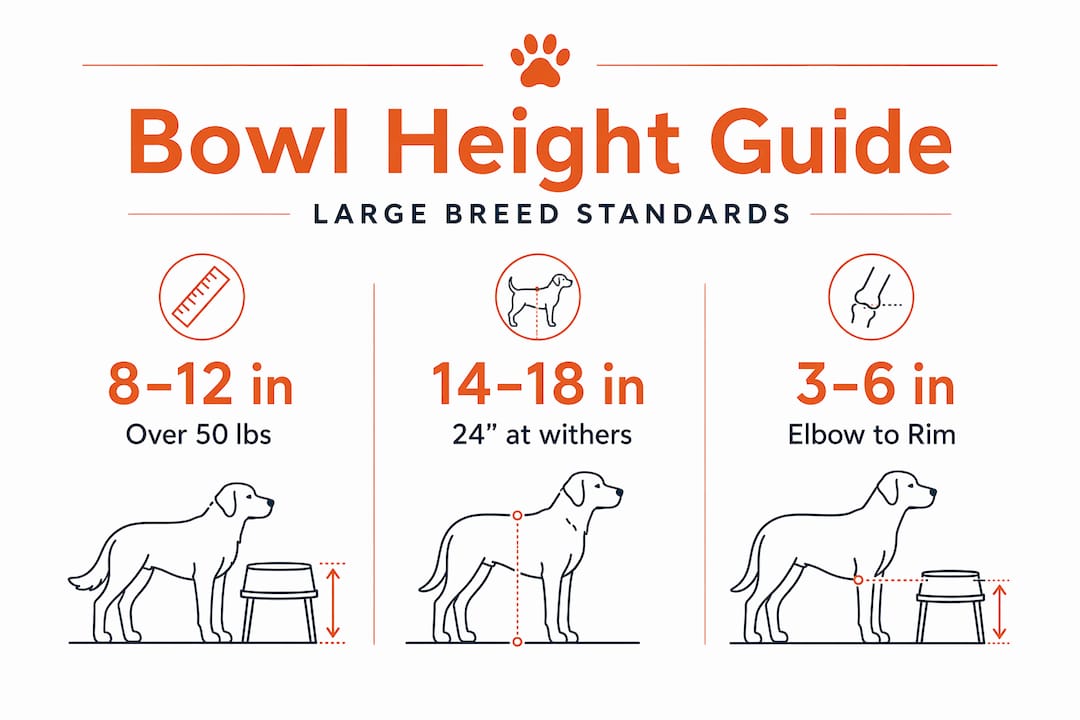
Veterinarians recommend 8 to 12 inches for dogs over 50 lbs and 14 to 18 inches for dogs 24 inches at the withers, specifically to maintain that neutral neck posture. But these ranges are starting points, not finished answers.
Pro Tip: Watch your dog eat for 30 seconds before making any changes. If you see the neck dipping sharply down or straining upward, that visual alone tells you an adjustment is overdue.
Potential health risks of elevated bowls for large breeds
Here is where many well-intentioned recommendations fall short. Raised bowls are frequently marketed as universally better for large dogs, yet the research on gastric dilatation-volvulus (GDV), commonly called bloat, tells a more careful story. GDV is a life-threatening condition in which the stomach fills with gas and rotates on itself. It can kill a large dog within hours if untreated.
“Deep-chested breeds like Great Danes, German Shepherds, and Standard Poodles carry a significantly higher genetic predisposition to GDV, and feeding method is one controllable variable in a multi-factor risk profile.”
A 2000 JAVMA study found that raised feeders were associated with 20% of GDV cases in large breeds and 52% in giant breeds, numbers that stopped many veterinarians from making blanket recommendations in favor of elevated bowls. More recent data from the Dog Aging Project confirms that large male dogs over 40 kg carry elevated GDV risk, with a lifetime prevalence of 0.23%.
| Breed type | GDV risk level | Elevated bowl recommendation |
|---|---|---|
| Large deep-chested (Great Dane, Weimaraner) | High | Use with caution; consult vet first |
| Large broad-chested (Labrador, Golden Retriever) | Moderate | Generally safe with correct height |
| Senior large breeds with arthritis | Low bloat concern | Often recommended for comfort |
| Giant breeds (Saint Bernard, Irish Wolfhound) | Very high | Vet guidance strongly advised |
The risk is not reason to dismiss elevated feeders entirely. It is reason to factor in your dog’s specific breed, sex, age, and eating behavior before deciding. The health risks of raised bowls are real but manageable when you approach feeding with awareness rather than assumption.
How to measure the correct bowl height for your large dog
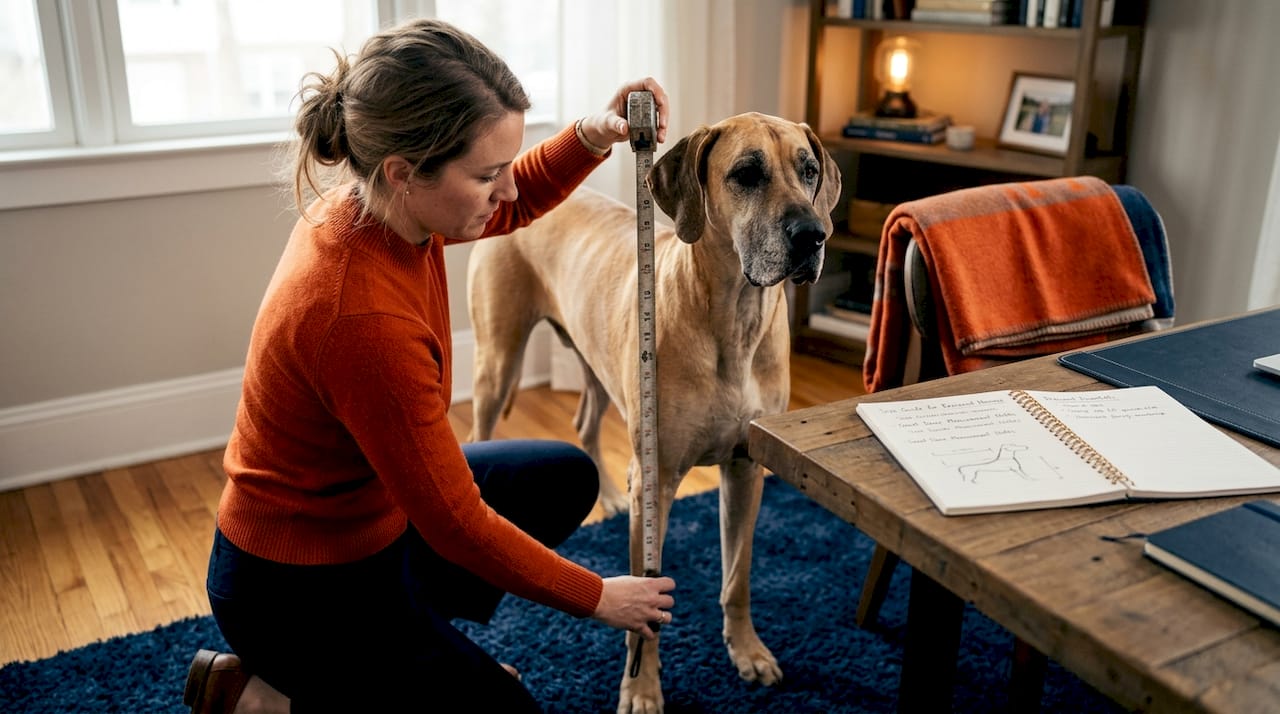
Measuring is the step most owners skip, and it is the most important one in this whole guide. The correct bowl height is personal to your dog, not decided by the feeder’s product label or a general size category.
Follow these steps for an accurate measurement:
- Stand your dog on a flat, level surface. Make sure they are relaxed and standing naturally, not crouching or stretching.
- Locate the elbow. Run your hand down the front leg to the joint where the leg bends. That point is the elbow.
- Measure from the floor to the elbow. Use a measuring tape held straight up. Record that number in inches.
- Subtract 3 to 6 inches. The lower end of that range (subtracting 6 inches) suits dogs that eat quickly or have bloat risk concerns. The upper end (subtracting 3 inches) works better for dogs with neck or spine stiffness.
- That result is your target bowl rim height. This measurement aligns the bowl with the lower chest and keeps the neck in a neutral position throughout the meal.
For a Great Dane with a 28-inch elbow height, for example, this calculation puts the ideal bowl height between 22 and 25 inches. That is considerably higher than what standard large-breed feeders typically provide, which is why measuring matters.
Pro Tip: Reassess the height every six months for growing puppies and once a year for adult dogs. Aging joints and changing muscle mass can shift the ideal measurement by an inch or two, and catching that shift early prevents unnecessary discomfort.
Adjustable elevated feeders earn their value here. A feeder you can fine-tune as your dog grows or ages is far more practical than replacing a fixed-height stand every few years. Check out dog bowl and stand sets that combine adjustability with a design you will actually want in your home.
Balancing comfort and safety: slow feeders and feeding strategies
Getting the height right is step one. Controlling eating speed is step two, and the two work together more than most owners realize. Fast eating is a significant independent risk factor for bloat in large breeds. When a dog gulps food rapidly, it swallows air along with each bite. That air accumulates in the stomach and, in deep-chested dogs, can trigger the cascade that leads to GDV.
The good news is that slow-feeder bowls combined with elevated feeders reduce rapid eating and associated air intake, which helps lower bloat risk while preserving the ergonomic benefits of the raised position. The two solutions reinforce each other.
Veterinary experts recommend slow feeders for large breeds prone to bloat, particularly when those dogs are also using raised bowls. The combination is not a guarantee against GDV, but it is a practical, low-cost way to reduce a controllable risk.
Key feeding strategies to combine with correct bowl height:
- Use a slow feeder bowl insert to break up meal portions and force your dog to work for each bite.
- Feed smaller, more frequent meals rather than one large meal. Two or three smaller portions reduce stomach distension.
- Avoid exercise 30 to 60 minutes before and after eating. Activity directly after a large meal significantly increases GDV risk.
- Monitor eating behavior. If your dog still inhales food despite a slow feeder, consider a puzzle feeder or lick mat as an alternative.
| Feeding method | Ergonomic benefit | Bloat risk impact |
|---|---|---|
| Floor level, regular bowl | None | Moderate (fast eating common) |
| Floor level, slow feeder | Minimal | Lower than floor regular |
| Raised, regular bowl | High for posture | Potentially higher for at-risk breeds |
| Raised, slow feeder | High for posture | Lower, especially combined |
Explore the slow feeding benefits for large dogs and consider raised slow feeder combinations as a practical starting point.
Choosing the right elevated feeder stand and bowls for your home and dog
Once you have your measurements and feeding strategy in place, the physical feeder itself needs to match your standards. Not all elevated feeders are built to the same quality, and for large breeds, stability is non-negotiable.
What to look for when selecting an elevated feeder:
- Anti-wobble base with rubber feet. Large dogs eating enthusiastically can tip lightweight stands, which startles them and discourages eating. Rubber feet also protect hardwood floors.
- Adjustable height settings. Fixed-height feeders are fine only if you never plan to reassess your dog’s needs. For most owners, adjustability is worth the investment.
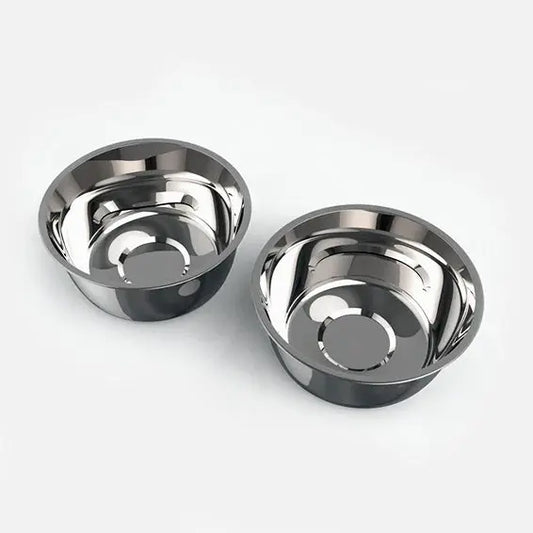
- Stainless steel or food-grade ceramic bowls. These resist bacteria buildup, are dishwasher-safe, and do not leach chemicals. Plastic bowls can harbor bacteria in micro-scratches even after washing.
- Appropriate bowl volume. A bowl that is too large visually encourages overfeeding. Match the bowl capacity closely to your dog’s actual portion size.
- Easy bowl removal. You will clean these bowls daily. If removal requires effort, it is a design flaw, not a feature.
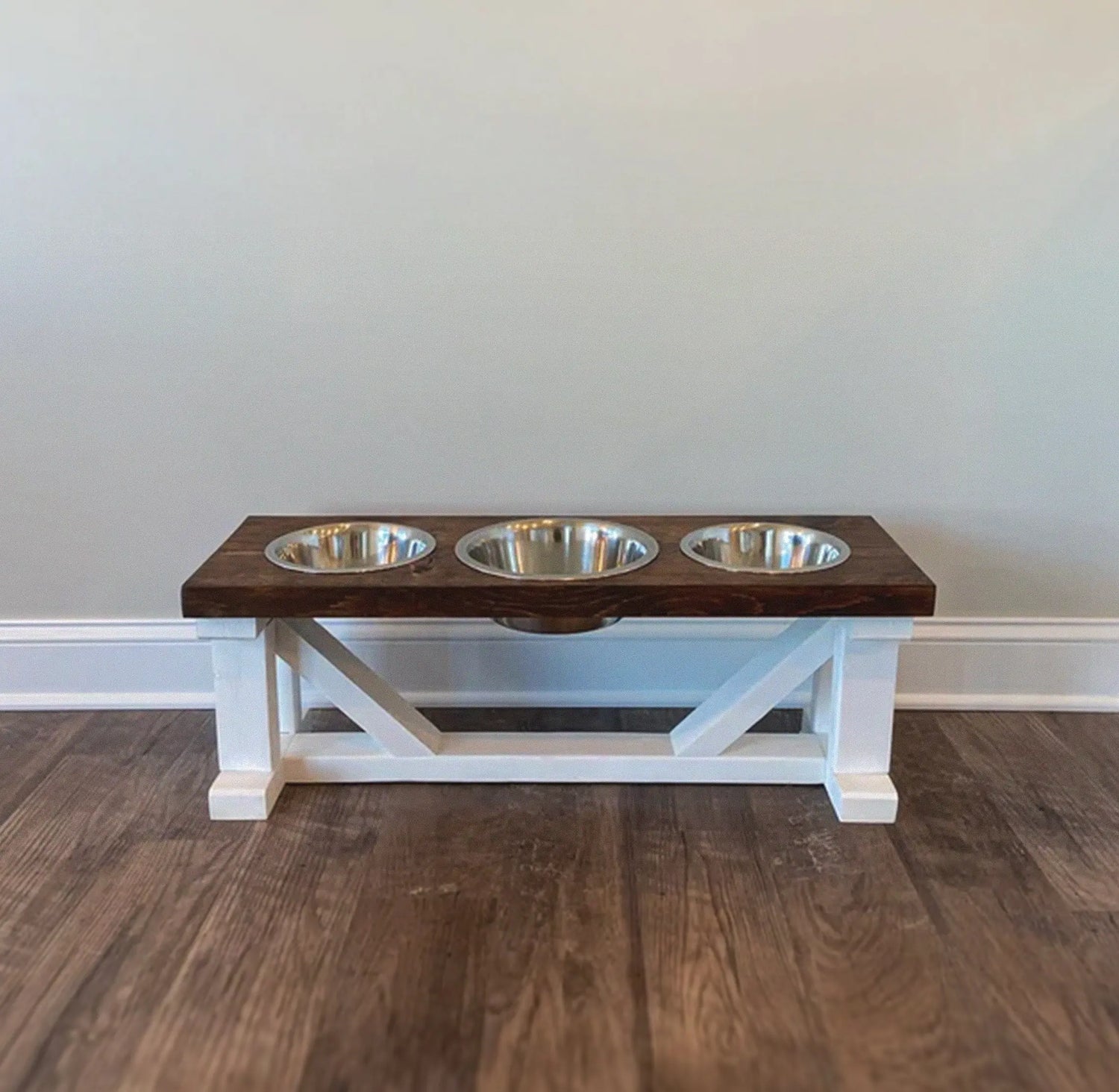
Prioritize stability, adjustability, and high-quality materials when evaluating feeders, alongside the correct bowl height your measurements determined. Aesthetic design matters too, especially when a large feeder will live in a visible area of your home. A well-crafted wooden or powder-coated metal stand can complement your interior rather than clash with it.
Browse luxury dog bowl and stand sets to see how form and function can genuinely coexist in one piece.
Why the conventional wisdom on raised dog bowls needs reconsideration
There is a version of this conversation that goes: raised bowls are better, full stop. Buy one, feel good about it, move on. That version is incomplete, and depending on your dog’s breed and health, it could be genuinely harmful.
The more honest framing is that raised bowl feeding exists on a spectrum of risk and benefit that shifts across a dog’s life. A two-year-old healthy male Great Dane, one of the highest-risk profiles for GDV, sits at a very different point on that spectrum than a twelve-year-old Golden Retriever with cervical arthritis. One size of advice does not fit both situations.
What we have seen over years of helping large breed owners is that the dogs who benefit most from ergonomic elevated feeding are often those whose owners also made adjustments over time: raising the stand as the dog aged, switching to a slow feeder when rapid eating appeared, or lowering the height slightly when a veterinarian flagged early signs of bloat risk. The decision to use elevated bowls must be individualized, with benefits for seniors potentially outweighing risks, while deep-chested breeds require ongoing caution.
This is not a reason to avoid elevated feeders. It is a reason to treat feeding furniture as a living decision rather than a one-time purchase. Your dog’s needs at age two look nothing like their needs at age nine. The best dog bowl height guide is not a static number; it is a practice of paying attention. Learn more about the nuances of senior dog elevated feeding to understand how those needs evolve.
Veterinary guidance matters most for deep-chested breeds and any dog with a known history of digestive issues. One conversation with your vet, armed with your dog’s elbow measurement and breed information, is worth more than any generalized recommendation.
Elevate your large dog’s feeding experience with Bearwood Essentials
Getting the feeding height right for your large breed dog is one of the most practical things you can do for their daily comfort. At Bearwood Essentials, we build elevated feeders specifically with large breed owners in mind: stable, adjustable, and designed to look good in your home.
Our adjustable elevated feeder for large dogs lets you dial in the exact bowl height your measurements call for, and adapt it as your dog grows or ages. If your dog eats too fast, pair it with our slow feed anti-bloat bowl to reduce air intake and slow mealtime down safely. For owners who want a dedicated single-dog setup, the large single elevated feeder delivers solid construction and clean design without compromise. Every product ships free across the U.S. on qualifying orders.
Frequently asked questions
What is the recommended bowl height for large dog breeds?
For large dogs over 50 lbs, bowl heights of 8 to 12 inches are the typical starting range. The most accurate method is measuring from floor to your dog’s elbow while standing, then subtracting 3 to 6 inches to align the bowl rim with the lower chest and maintain a neutral neck position.
Are elevated dog bowls safe for all large breeds?
Not universally. Raised feeders are linked to 20% of GDV cases in large breeds, with deep-chested dogs like Great Danes and German Shepherds at highest risk. Safety depends on your dog’s specific breed, sex, age, and eating behavior, so consulting your veterinarian before use is strongly recommended.
How can I reduce bloat risk while using elevated bowls?
Pairing the correct bowl height with a slow feeder bowl reduces rapid eating and limits air intake during meals, which lowers bloat risk for large breeds without giving up the ergonomic benefits of raised feeding.
How do I measure the correct elevated bowl height for my dog?
Measure floor to elbow while your dog stands naturally, then subtract 3 to 6 inches. The result is the target bowl rim height that keeps the neck neutral and reduces strain during every meal.
Should senior large dogs have elevated bowls?
Yes, in most cases. Senior dogs with arthritis or neck pain often benefit significantly from elevated bowls that reduce the need to bend down. Height should be reassessed periodically as mobility changes, and the ergonomic benefits for seniors commonly outweigh the bloat concerns that apply more to younger, healthy deep-chested dogs.